

Finding the right balance: choosing a cane



Choosing the right walking cane for you depends on what kind of balance support you need. You might need a cane during recovery from surgery or illness or to help you prevent falls. Single-point canes offer faster mobility but less balance support while quad canes can provide significant balance support, but slower mobility. Talk with your doctor or physical therapist to get advice on which type of cane is right for you.
When you need a walking cane, there might be a moment where you think “I'm not strong anymore.” Well, we’re here to tell you that you are strong enough because a walking cane isn’t a sign of weakness — it’s a power move.
Having the support and balance you need while walking outside, moving around the house, or just doing what you want to do is a powerful thing, and it tells the world you’re taking charge of your life.
A walking cane can be a fantastic mobility support that helps you during recovery from an illness or injury or if you just need a little more balance. The real hard part about having to use a cane? Choosing one from all the available options. Let’s take a look at why you might need a cane, the different types, and how to choose the right one for yourself.
Why you might need a cane
There are a lot of different reasons you might want or need a cane or why your doctor or physical therapist recommends one. Here are some of the most common:
Balance support: If you feel unsteady while walking, a cane can help prevent falls.
Injury recovery: A cane can support you if you’re recovering from a leg, foot, or ankle injury by reducing weight-bearing pressure.
Post-surgery recovery: After surgery, you may use a cane to help you recover.
Chronic pain: A cane may help reduce the strain on your joints or muscles, especially if you have arthritis, fibromyalgia, or back pain.
Confidence while walking: You might use a cane for reassurance and support while walking and to help prevent falls.
When a cane helps you walk freely, it can help you perform other activities of daily living (ADLs) like walking to the bathroom to use the shower or instrumental activities of daily living (IADLS) like walking around the store to shop for groceries.
Canes vs. walkers
All this talk about canes might have you thinking, “what about walkers?”
Canes and walkers both offer mobility support, but the main difference is that walkers offer even more support because they require two hands. If you’re using a cane in one hand but frequently grabbing furniture or the wall with the other hand to help you balance, you may need the two-handed support of a walker.
What are the different types of canes?
Walking canes come in all shapes, sizes, and some pretty fun colors, too. Canes are all about giving you balance support. The amount of support can depend on the tip of the cane that touches the floor.
Single-point cane

The single point cane has a single point that touches the ground. These canes typically have an offset or curved handle at the top. They offer faster mobility, but the least amount of balance support.
Single-point canes also don’t stand up on their own. If you sit down or get into bed, you’ll have to lean the cane against something.
Quad cane
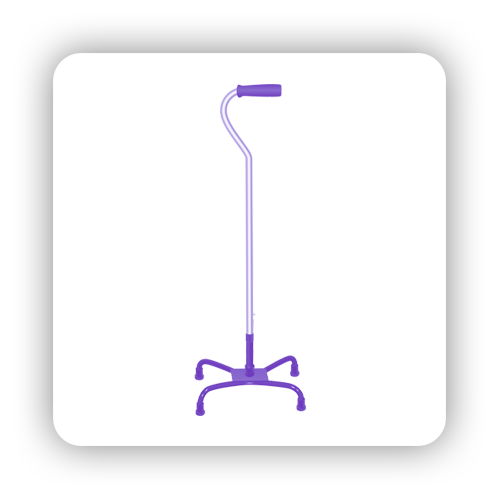
The quad cane is a sturdy cane that features a four-pronged tip that touches the floor. This cane is one of the sturdiest canes and provides a significant amount of balance and weight support. With its wide quad base, this cane can stand on its own on most surfaces.
Quad canes tend to offer slower mobility because they are bulkier, must be placed flat on the ground, and the outside legs of the quad tip must face away from you, so you don’t trip.
Cane features to consider

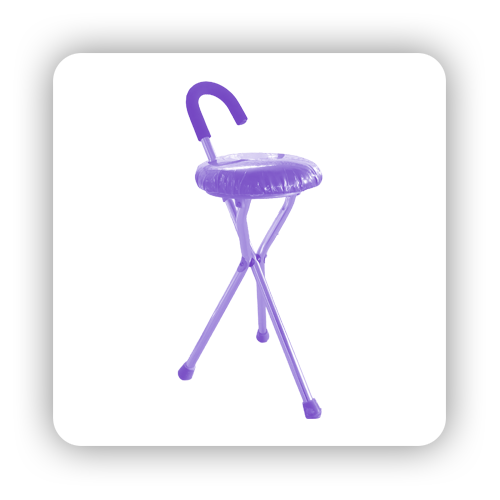
Generally, single-point and quad are the main types of canes, but you can find canes with other designs, such as three points or single points with a quad base.
You’ll also find that canes can have all sorts of features. Consider some of these options when choosing your cane:
Collapsible shafts so you can stow your cane in a bag
Lights for visibility
Mid-shaft handles to help support you stand up and sit down
Removable tips for different surfaces such as indoor and outdoor use
Canes with built in seats
A note on cane handles

You’ll also see different types of cane handles that are straight, curved, vertical, plastic, foam, or have wrist support.
Start by determining how much balance support you need at the base. From there, you can look at which canes offer the right combination of base support and hand comfort.
Choosing a cane that’s right for you
Whether you’re just starting to research options or standing in the cashier’s line at the store, ask yourself these questions. Your answers will help you choose what’s right for you.
How much support is needed?
How much pressure is put on the cane?
How much weight bearing is available on my left and right leg?
Where will I be using the cane?
Do I live in an area with a cold climate that requires extra grip on my cane?
Safety tips when using a cane
Here are some general tips to safely use your walking cane:
It’s all about comfort. When trying a cane make sure the grip and base of support feel comfortable to you.
Most canes have adjustable heights. Generally, a cane is at the proper height when the hand grip reaches the crease of your wrist.
A cane is typically used on the opposite side of the weakest leg to offer you the most stability.
If both your legs have the same amount of strength, you can use the cane in either hand to give each arm, palm, and wrist some relief.
When using the cane, keep it a slight distance from your side. This can help prevent you from tripping.
Make your choice easy
If you’ve looked at all the cane options, considered all the pros and cons, asked yourself all the questions, and still don’t know which cane to choose, talk to your doctor or physical therapist. They’ll be able to help you choose a cane that is comfortable and gives you the right amount of support.
Remember, choosing a cane is about giving you balance, support, and comfort so you can continue to get where you want to go.
Take a step toward quality care
Finding quality care is even easier than finding a cane. If you’re looking for in-home care, search the CareScout Quality Network
Expert reviewed by


Jessica Richards, DPT
Jessica Richards is a licensed Doctor of Physical Therapy with an extensive background working with older adults in home health. She now serves as a Care Management Specialist on the Live Well | Age Well team at Genworth, helping policyholders improve home safety and efficiency with the activitie...
Written by

Brian Dowd
Brian is writer based in New England. He is a passionate storyteller with a knack for finding the extraordinary in the ordinary. He joined CareScout as a Senior Content Writer in 2024. Before that, he worked as a content writer in the senior living industry and worked for several years as an assi...