

States Where $250K in Long-Term Care Savings Goes Furthest



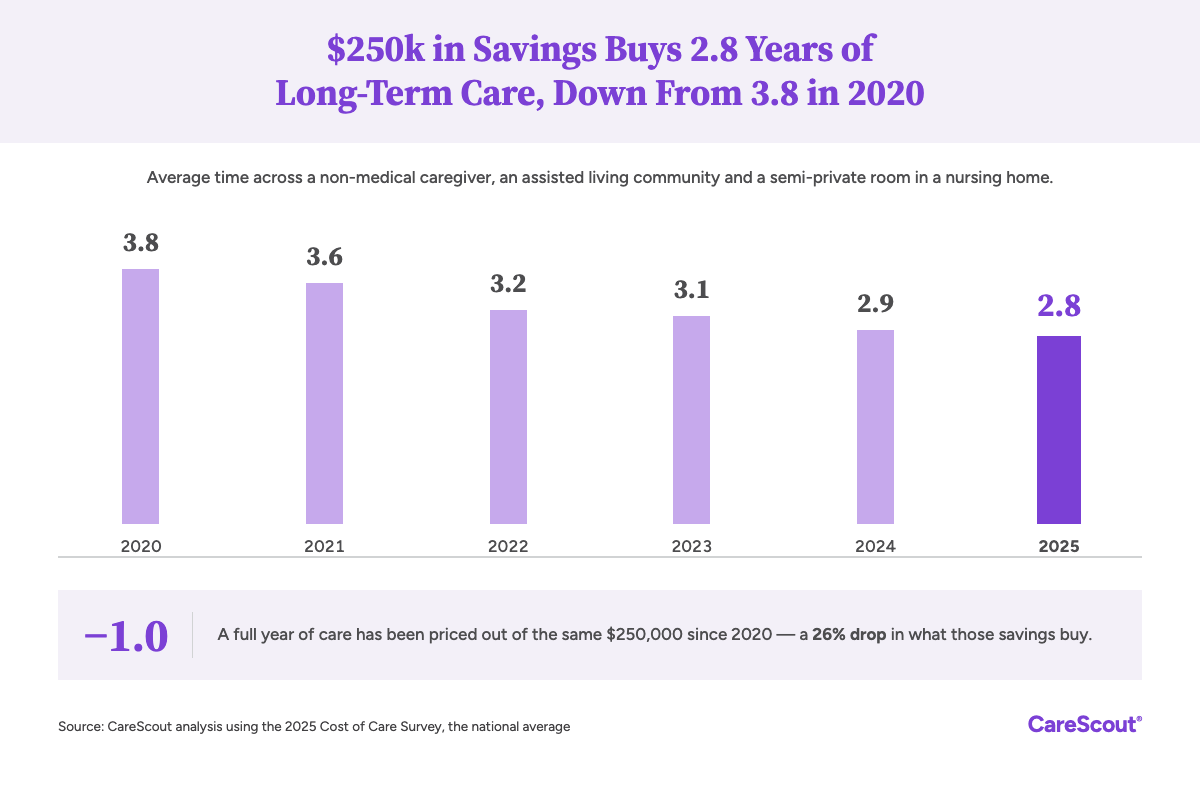
-$250,000 Covers 2.8 Years of Long-Term Care on Average, Down from 3.8 in 2020
-$250K Lasts Longest in Arkansas, Runs Out Fastest in Hawaii and Alaska
A record 64.6 million Americans were 65 or older in 2025, up 16.2% in just five years, according to the U.S. Census Bureau. At the same time, life expectancy reached a record high of 79 years in 2024, topping the pre-pandemic peak set in 2019.
The data underscores a looming senior care crisis, making it critical for Americans to plan ahead and explore long-term care options as best they can.
The U.S. Department of Health and Human Services, estimates that 70% of Americans over the age of 65 will need long-term care at some point in their lives.
Many Americans have a misconception that Medicare pays for long-term care. When a long-term care event takes place, they can unexpectedly find that it does not, and they have to rely on savings. Due to the rising cost of care, long term care recipients are getting less bang for their buck each year.
For a couple that has saved $250,000, that now covers just 2.8 years of long-term care on average nationally—the lowest level this decade. In 2020, the same amount covered a full year more, 3.8 years, and that number has fallen every year since.
 How far long-term care savings can go varies by state, making it an important factor when deciding where to retire.
Using data from its most recent 2025 Cost of Care Survey, CareScout calculated how long $250,000 would cover the median cost of three common long-term care settings in every state: in-home caregiving, assisted living, and a semi-private room in a nursing home. The cost figures presented below for different care settings are based on the national and state median cost of care figures. The actual cost for care in each state is dependent on the specific locale and care provider selected and may be higher or lower than the median costs presented here.
Then, to understand where seniors are even able to afford $250,000 in the first place, we analyzed senior households' median net worth, including financial assets, retirement account savings, and home equity, in each state using Census Bureau data.
The results indicate that aging Americans face distinct challenges planning for long-term care, no matter where they live. In the cheapest states, including Arkansas, Mississippi and Alabama, $250,000 can cover nearly four years of care—but many senior households there won’t have anywhere close to that amount saved.
Meanwhile in the most expensive states—including Hawaii and Massachusetts—the typical senior households’ net worth is well above $250,000, but even that isn't enough. Seniors’ savings can run out quickly given the sky-high costs of nursing homes, assisted living communities and in-home care in high-cost states.
Key Findings
Coverage at lowest levels this decade. $250,000 now covers 2.8 years of long-term care nationally, down from 3.8 years in 2020. The figure has fallen every year since.
Nursing homes drain it fastest. By setting, $250,000 covers 3.4 years of assisted living, 3.1 years of in-home caregiving and 2.2 years in a semi-private nursing home room.
Cheapest care, thinnest cushions. Eleven states have a typical senior household net worth below $250,000. Eight of them also rank in the top 10 for how far $250,000 goes. Long-term care is generally most affordable in the states where families are least able to afford it.
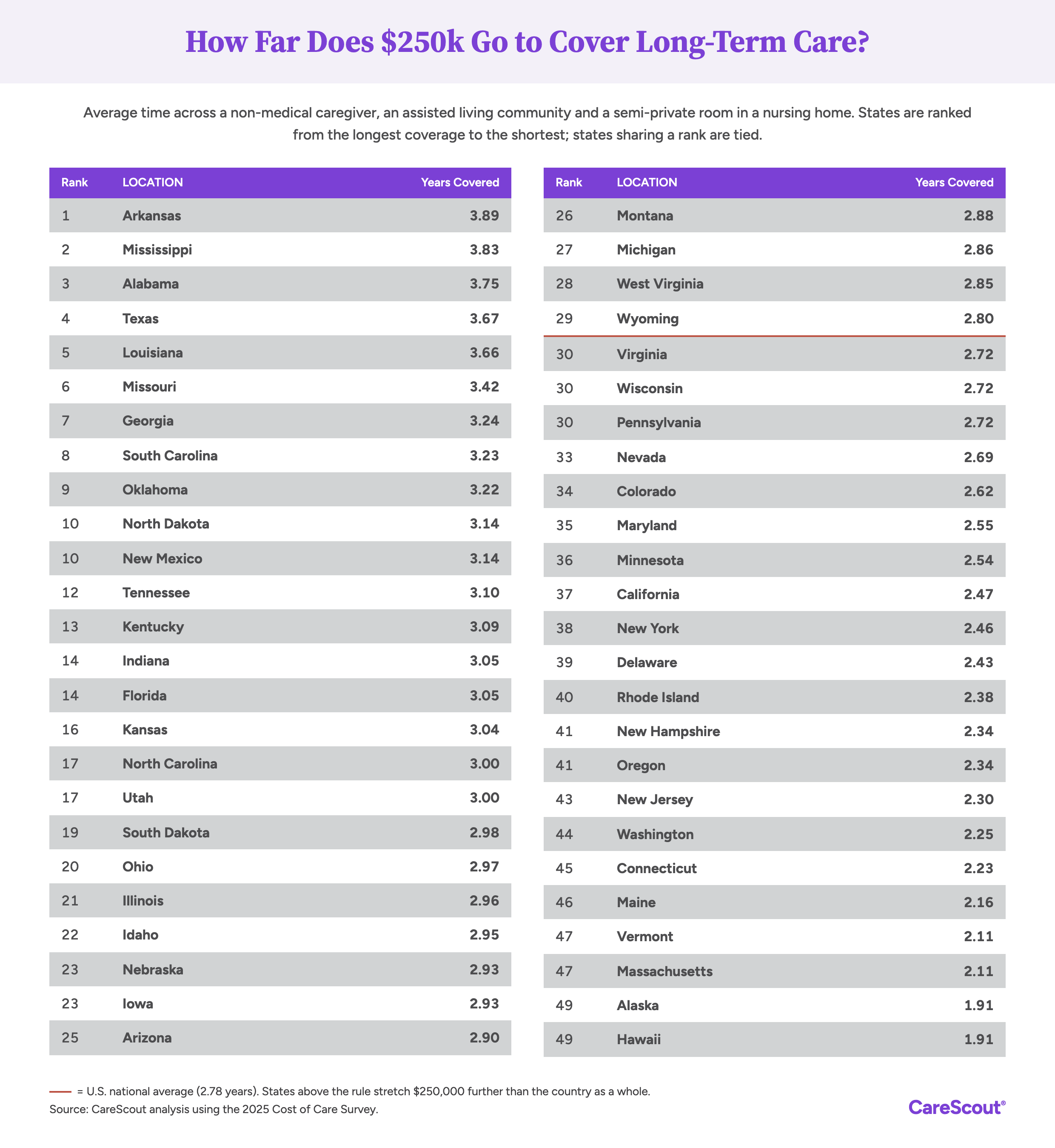
Arkansas doubles Hawaii. The same $250,000 buys twice as much time in Arkansas, at 3.8 years, as in Hawaii or Alaska, at 1.9 years each.
New York loses twice. It is the only state with both a typical senior net worth below the benchmark, at $239,040, and below-average coverage at 2.46 years, 38th nationally.
The South stretches it furthest. $250,000 covers an average of 3.20 years across the region. The Northeast gets the least at 2.31 years.
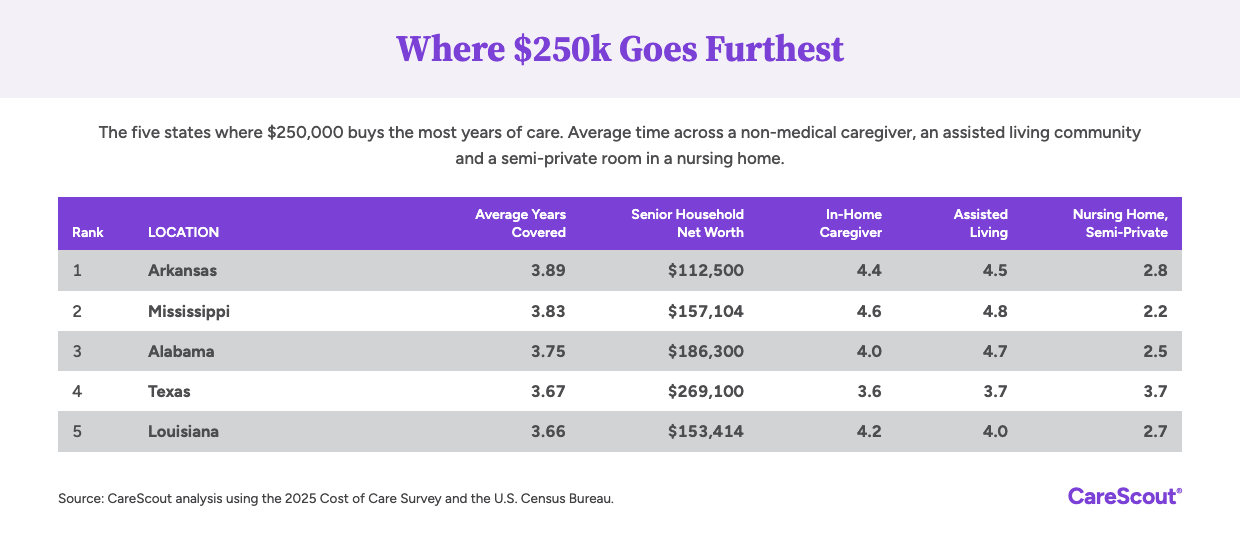
Best States: Where $250K Goes Furthest
Arkansas: 3.9 years. The cheapest overall combination of the three care settings, driven by in-home caregiving at $57,200 per year and assisted living at $55,644 per year.
Mississippi: 3.8 years. Home to the nation's lowest in-home caregiving and assisted living costs, though a median nursing home cost of $114,975 per year keeps it just behind Arkansas.
Alabama: 3.8 years. In-home caregiving ($61,776 per year) and assisted living ($53,100 per year) both come in well below the national median.
Texas: 3.7 years. Notably, Texas is the only state in the top five where a typical senior household can actually cover the $250,000 benchmark from their net worth alone. It also has the nation's cheapest nursing home care at $67,525 per year for a semi-private room.
Louisiana: 3.7 years. Low costs across the board keep it in the top tier, with assisted living at $61,950 per year and caregiving at $59,488 per year.
Every one of the five best states sits in the South, and four of the five—all but Texas—are states where a typical senior household’s net worth falls short of $250,000. That means the states where the money goes furthest for long-term care are largely not the states where families are most likely to have that much saved.
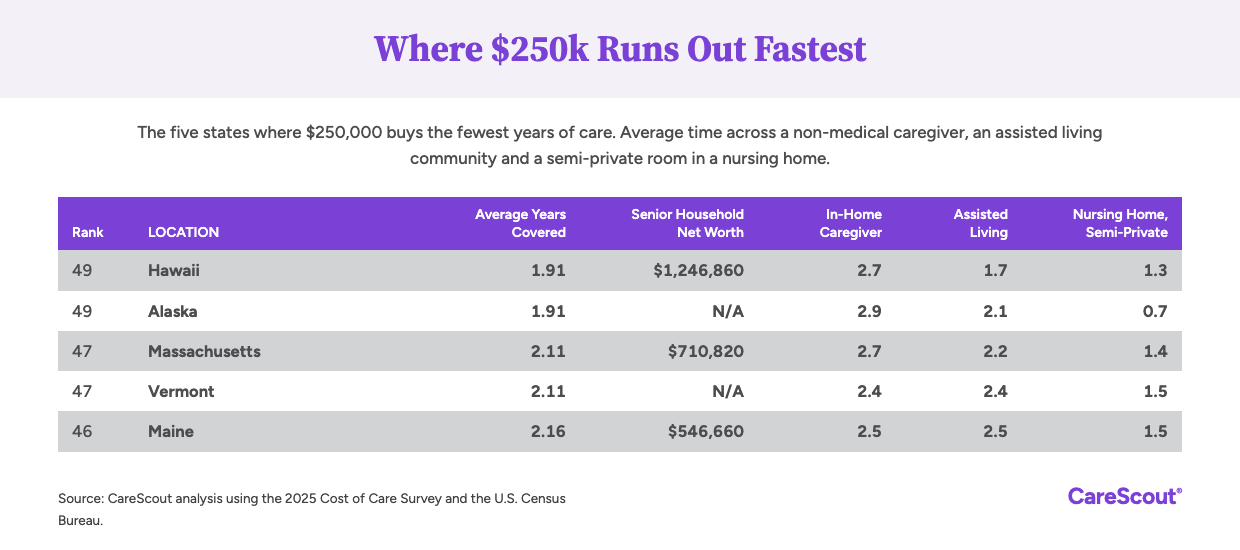
Worst States: Where $250K Runs Out Fastest
Alaska: 1.9 years. The single biggest reason: a semi-private nursing home room costs $333,975 per year, by far the highest in the nation. That means $250,000 would barely cover nine months in that setting.
Hawaii: 1.9 years. Every long-term care setting is pricey in Hawaii, but assisted living is the standout at $145,155 per year, the most expensive in the country.
Vermont: 2.1 years. It has high costs across all three settings, including $103,167 per year for assisted living.
Massachusetts: 2.1 years. A nursing home semi-private room runs $173,375 per year, well above the national median.
Maine: 2.2 years. Assisted living is $98,460 per year and nursing home care is $167,718 per year, which both push Maine into the bottom five.
Three of the five worst states have a typical senior net worth above $250,000—in Hawaii's case, roughly $1.25 million, followed by about $711,000 in Massachusetts and $547,000 in Maine. (Net worth data was not available for Alaska or Vermont.) This indicates the high cost of living in these states cuts both ways: it inflates senior households’ net worth through home equity and other assets, but it also brings up the price of long-term care.
Where $250K Goes Furthest by Region
The South stretches $250,000 the furthest of any Census region, at an average of 3.20 years across its 16 states, and it also has the lowest average senior household net worth of any region at roughly $265,000. The Northeast is its mirror image: the shortest coverage at 2.31 years, paired with an average senior net worth of about $519,000.
The Midwest sits in the middle at 2.96 years, and the West averages 2.60 years—though the West is the most internally divided region in the country, spanning New Mexico at 3.14 years and Hawaii at 1.91.
Regional averages conceal real variation, and families should look at their own state rather than their region. Delaware, for example, ranks 39th nationally despite sitting in the South, and Pennsylvania is the strongest performer in the Northeast at 2.72 years.
Can Seniors in Each State Actually Afford $250,000 in Long-Term Care?
Knowing how far $250,000 goes is only half the picture—the other half is whether a typical senior household in that state will be prepared to spend that amount on long-term care. We analyzed household net worth data from the Census Bureau, adjusting it for age (see full methodology below) to identify where seniors are best positioned.
We found that the states where long-term care is cheapest—and therefore, where $250,000 lasts longest—are disproportionately the states where seniors are least likely to have $250,000 saved. What’s more, several of the states where seniors are wealthiest on paper still can't make that sum last beyond a couple of years, given the higher costs of long-term care there.
Eleven states have a typical age-adjusted senior household net worth below $250,000: Arkansas, New Mexico, Oklahoma, Kentucky, Louisiana, Mississippi, Alabama, West Virginia, Missouri, South Carolina and New York. Four of them—Arkansas, Mississippi, Louisiana and Alabama—are also in the top five for how far $250,000 stretches.
At the other end of the spectrum, a $250,000 nest egg is easiest to imagine saving in states like Hawaii ($1.25 million typical senior net worth), Washington (nearly $822,000) and New Hampshire (about $743,000). However, those are among the states where the money buys the least time once seniors actually start paying for long-term care (1.9 years, 2.3 years and 2.3 years, respectively).
Seven states lacked data on household net worth: Alaska, Delaware, North Dakota, Rhode Island, South Dakota, Vermont and Wyoming.
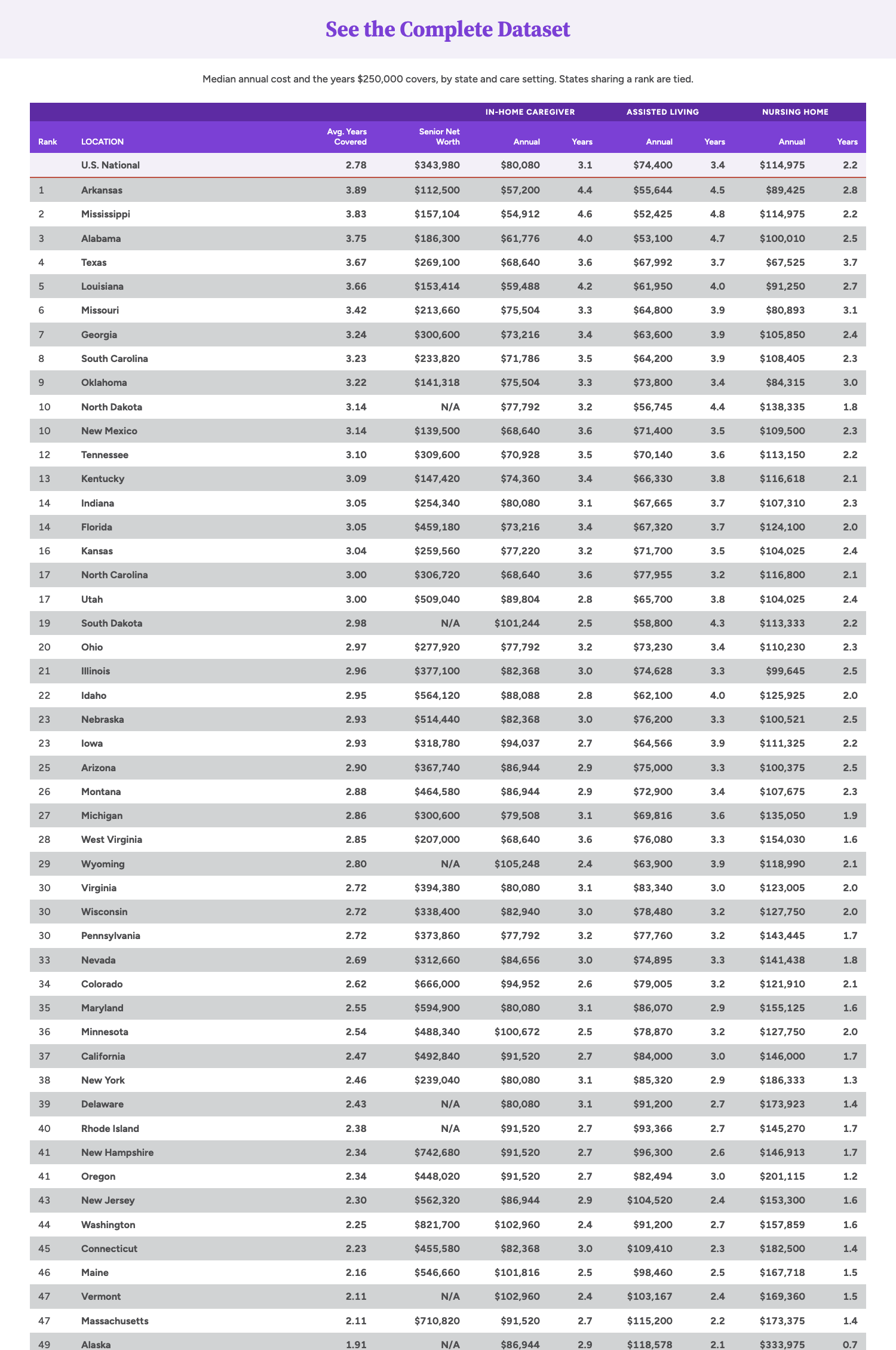
Full State-by-State Data
Median annual prices for long-term care vary by setting, affecting how far $250,000 can go. Mississippi, for example, has the lowest costs for in-home caregiving ($54,912 per year) and assisted living ($52,425 per year) of any state, while Hawaii has the highest assisted living cost ($145,155 per year) and Wyoming has the highest caregiving costs ($105,248 per year).
Check out CareScout's complete 2025 Cost of Care Survey here and the full dataset behind this report below.
Tips for Families Considering Long-Term Care
Plan for a blend of care settings, not just one. Most people don't spend their entire long-term care journey in a single setting. They may move from in-home care to assisted living to a nursing home as needs escalate. Budgeting only for the cheapest setting can leave a family short at exactly the point when costs spike, and this analysis shows the three settings can differ by well over a year of coverage within the same state.
Price care where you plan to retire, not where you live now. A move across state lines can change your care runway by two full years on the same savings, as this analysis shows. If retirement plans include relocating, run the numbers for the destination before you go, and remember the trade works both ways: low-cost states stretch a nest egg further, but they're also where home sale proceeds are smallest.
Conclusion
While $250,000 is a useful benchmark for long-term care spending, it isn't a fixed answer. Instead, think of it as a starting point that can stretch or shrink dramatically depending on your state’s cost of living and your household finances. Families in low-cost states get more mileage from the same savings amount, but are also less likely to have that much saved to begin with. Meanwhile, families in high-cost states are more likely to clear the benchmark, but often find it isn't enough once long-term care costs arrive. Understanding both halves of that equation can help families begin to plan for long-term care.
Methodology
We used CareScout’s 2025 Cost of Care Survey to identify median annual costs for an in-home non-medical caregiver, an assisted living community and a semi-private room in a nursing home in all 50 states. We divided $250,000 by each of those three costs to calculate how many years those savings would cover, then averaged the three figures for each state to produce a single score and ranked states accordingly. This average is a composite affordability measure, given most families use a sequence of care settings rather than paying for all three simultaneously.
To understand where seniors are likely to have $250,000 in the first place, we also analyzed senior households' median net worth, including financial assets, retirement account savings, and home equity, using Census Bureau data. We adjusted median household net worth for seniors to reflect that typical senior households hold about 80% more net worth than the national average household, based on Census data. We calculated these estimates for a recent CareScout analysis on States Where Seniors Are Most and Least Likely to Outlive Their Savings.
For seven states—Alaska, Delaware, North Dakota, Rhode Island, South Dakota, Vermont and Wyoming—state-level net worth data wasn’t available from the Census Bureau. Rather than substitute a national figure, we've marked these states' net worth comparison as not available.
Written by


Christine Healy
Christine Healy is the Head of Brand at CareScout. A growth strategist with over two decades of experience, Christine specializes in scaling mission-driven organizations across aging care, early education, and educational travel. She has previously held executive marketing roles at Bright Horizon...