
Where senior care costs are rising fastest across the U.S.



Senior Care Costs Surged Dramatically Since 2022 But Show First Signs of Slower Growth in Care Costs Since COVID
Hawaii Saw the No. 1 Fastest Rise in Costs, Idaho the No. 1 Slowest
What happens when you combine a record 61.2 million American seniors and lingering post-pandemic inflation?
You get senior care costs that have gone through the roof, putting unprecedented financial pressure on households, and on public programs like Medicaid and Medicare.
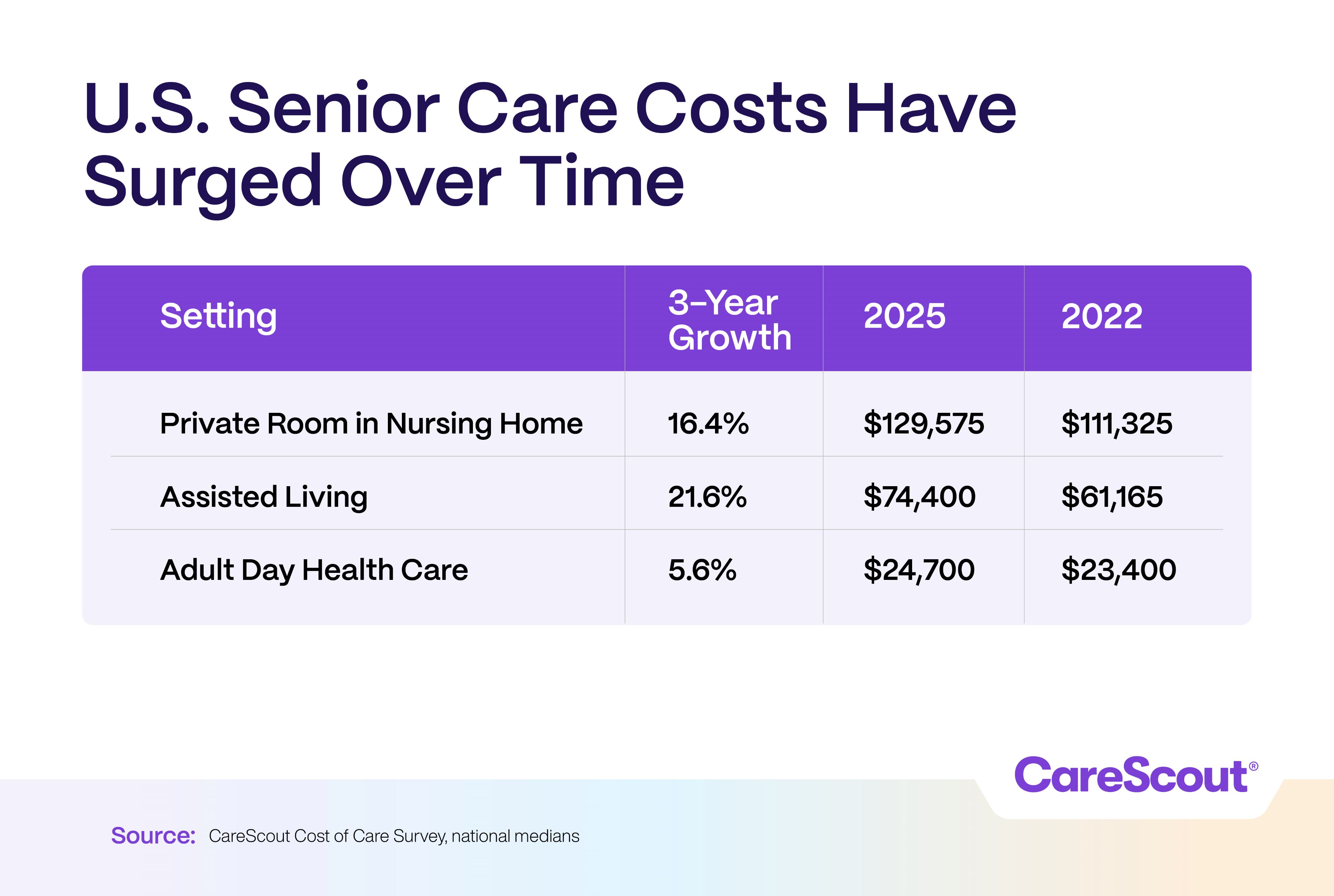
Since 2022, according to CareScout’s Cost of Care Survey data, a private room in a nursing home increased by 16.4% and assisted living costs rose 21.6%. Adult day health care costs, traditionally the most affordable option, rose at a slower pace of 5.6% over the same period.
For families planning care for aging loved ones, these numbers aren't abstract. They translate into tens of thousands of additional dollars in out-of-pocket spending.
CareScout's 2025 Cost of Care Survey found the annual median cost of a private room in a nursing home now exceeds $129,000 per year, while a semi-private room tops $114,000. This underscores a dramatic escalation in prices for the most intensive long-term care services in recent years. Assisted living costs have also climbed to around $74,400, and adult day health care costs are approaching $25,000.
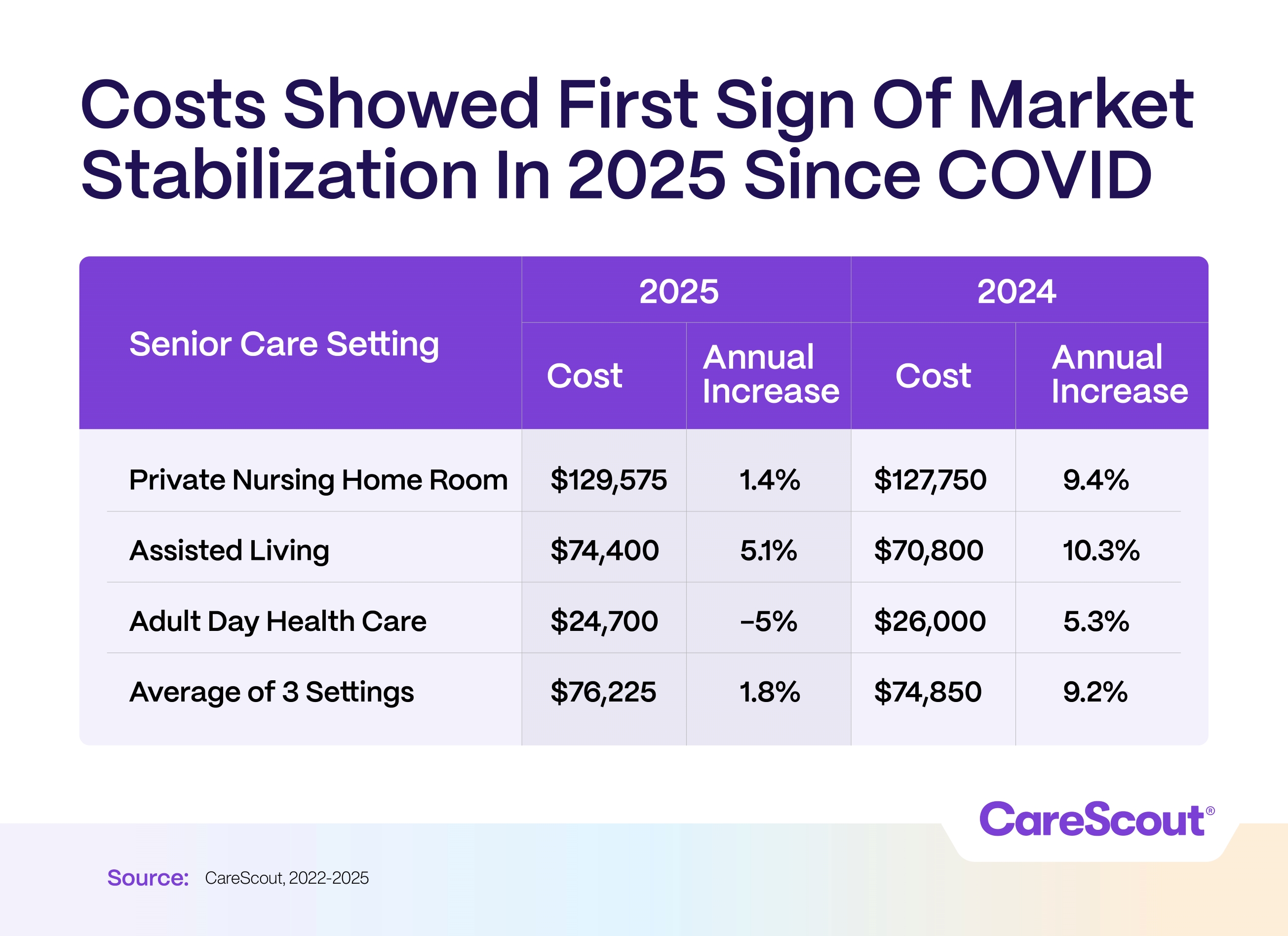
Notably, in 2025 seniors care costs showed the first signs of slowing since the end of the COVID-19 pandemic. If this holds true going forward, it would provide some much-needed relief to families.
On average, CareScout’s data show that costs for private rooms in nursing homes, assisted living and adult day health care rose by 1.8% across the U.S. last year, compared to 9.2% in 2024, 5% in 2023 and 7.2% in 2022.
But there's a crucial divide beneath these national figures. States vary widely in how fast prices are rising and how high they stand today, creating vastly different financial landscapes depending on where a family lives.
To find out where senior care costs are rising the fastest, CareScout analyzed data from its annual CareScout Cost of Care Surveys from 2022 and 2025.
We compared annual median costs across four settings:
A private room in a nursing home
A semi-private room in a nursing home
Assisted living
Adult day health care.
Key State-by State Findings
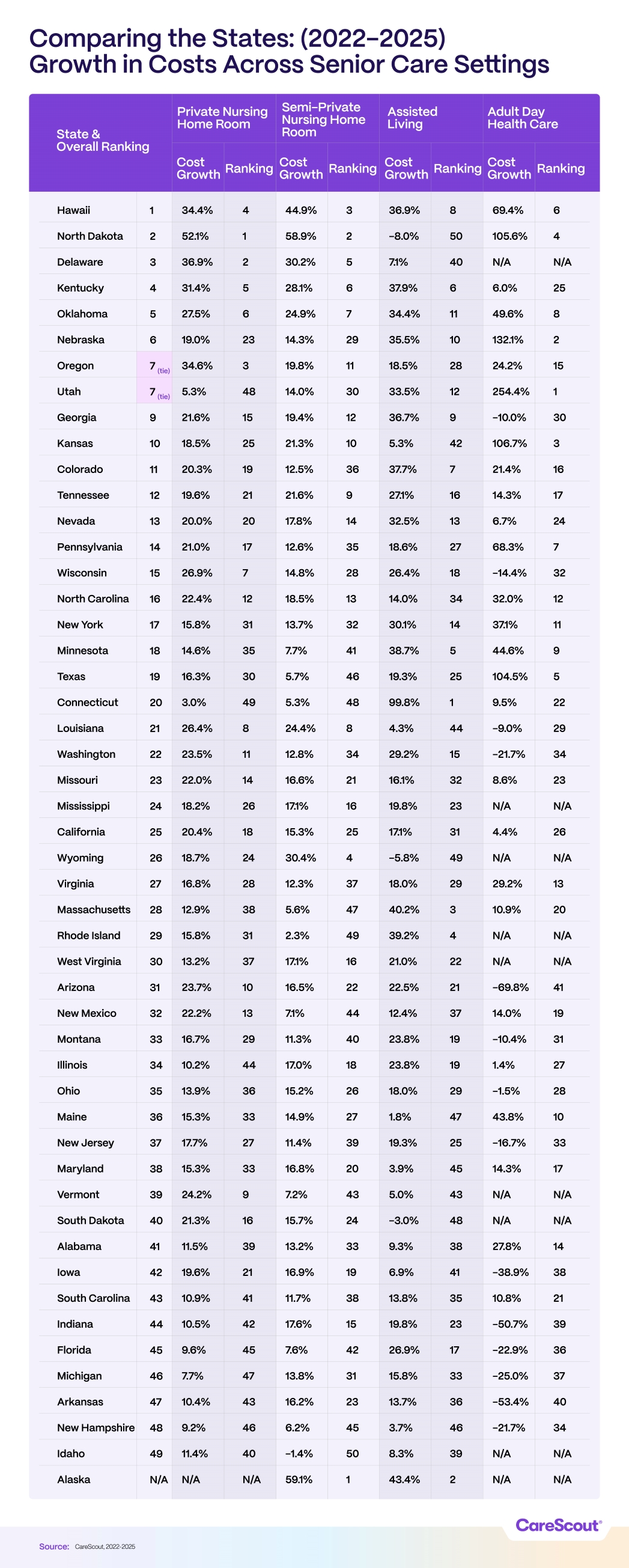
Hawaii Ranks No. 1: Senior care costs are rising fastest in Hawaii, which ranks in the top 10 across all four care settings. Costs for a private room in a nursing home rose 34.4%, while a semi-private room increased by 44.9%, adult day health care climbed 69.4% and assisted living costs rose 36.9%.
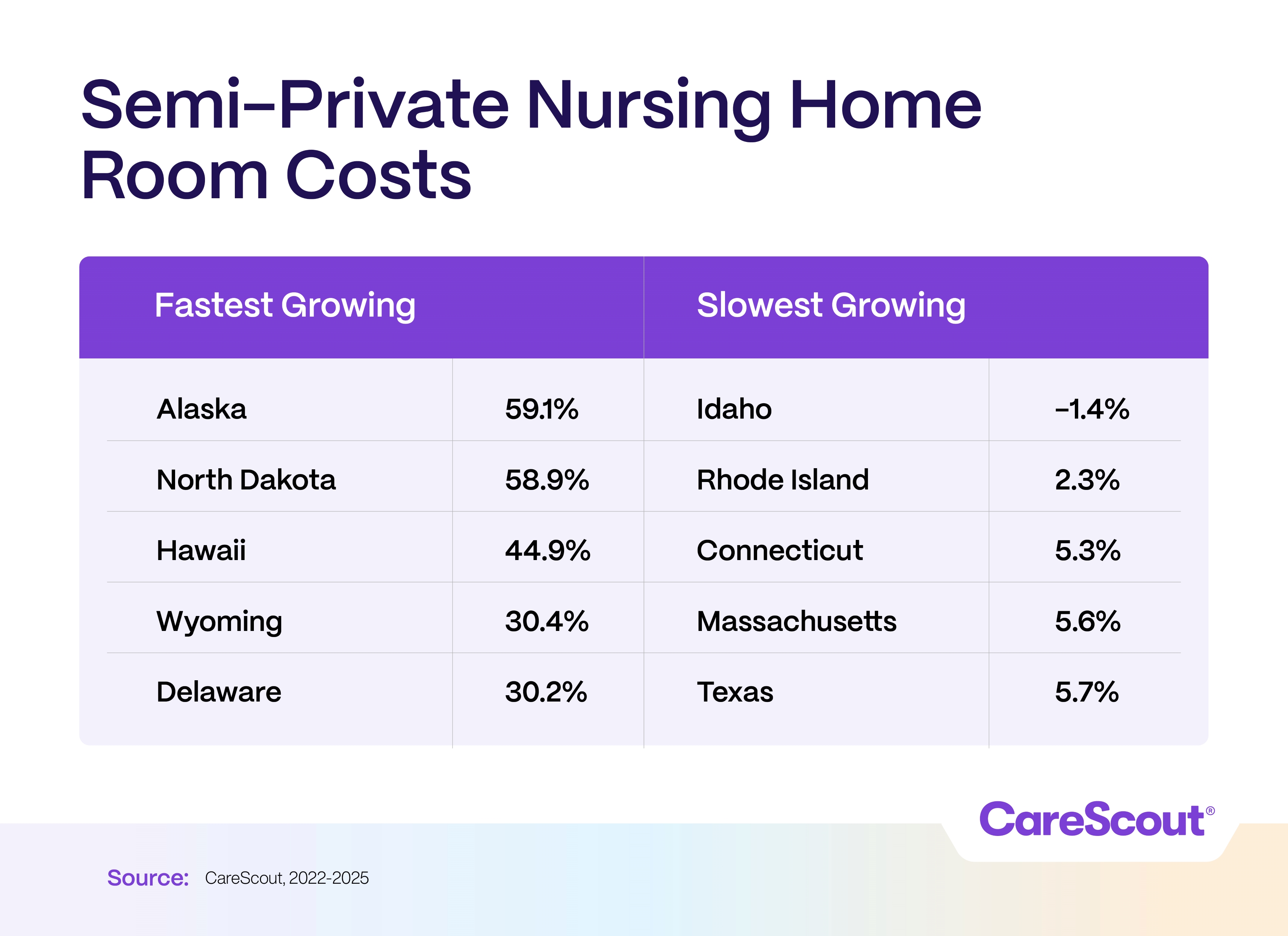
Idaho is the Most Stable State: It was the only state where semi-private nursing home costs actually declined (-1.4%), though they still cost families an average of $125,925 in 2025.
Clear Regional Divide: Costs are climbing fastest in the Mountain West, Upper Midwest and parts of the South, while New England and several mid-Atlantic states have seen slower, more predictable growth.
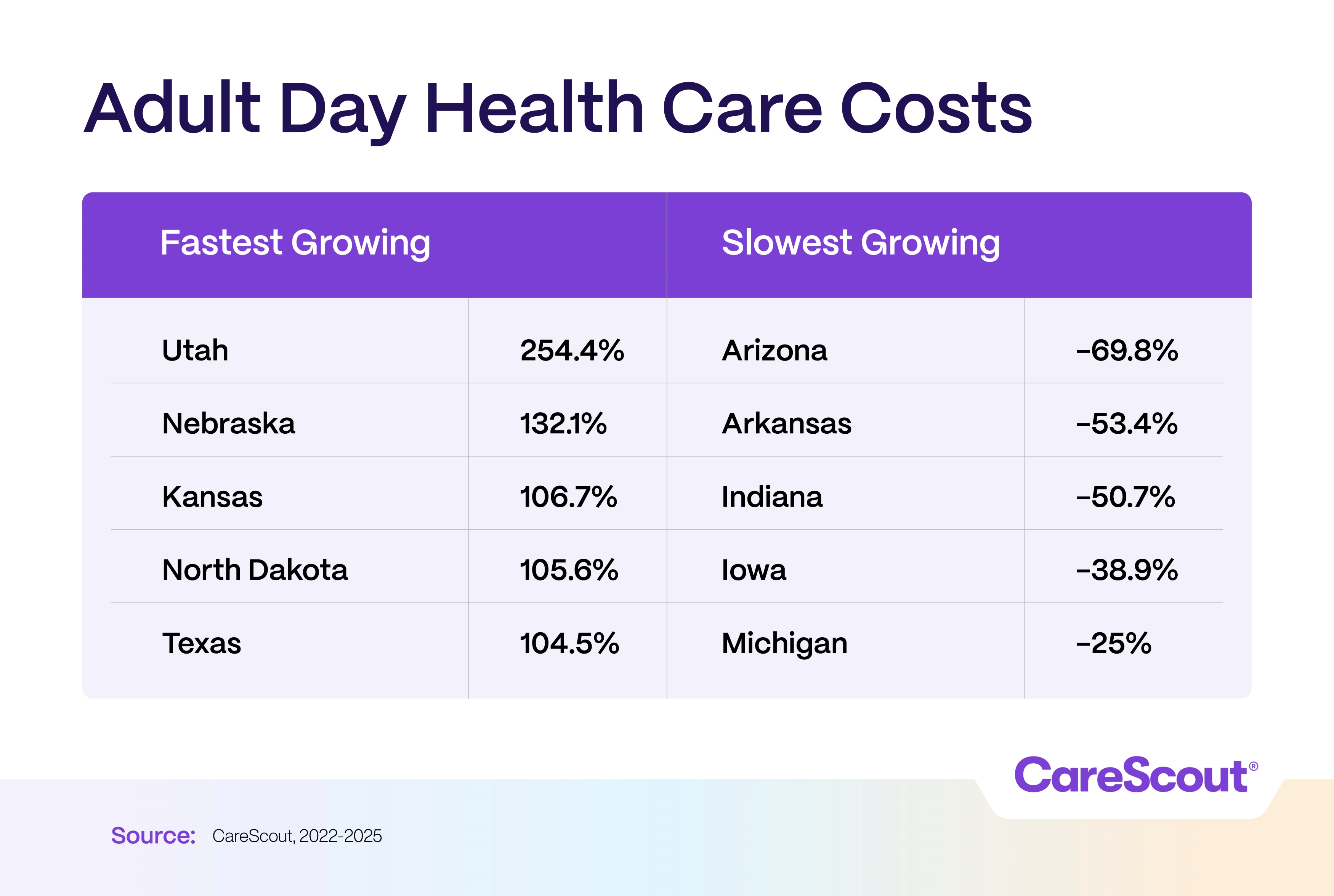
Costs Are Rising Unevenly and Unpredictably: No. 7 Utah saw the largest single-category spike in the country (254.4% for adult day health care), while private nursing home room costs rose by only 5.3%, the second-slowest rate in the U.S. That means families must be diligent about comparing costs across settings, even within a single state.
Where Costs Are Rising Fastest
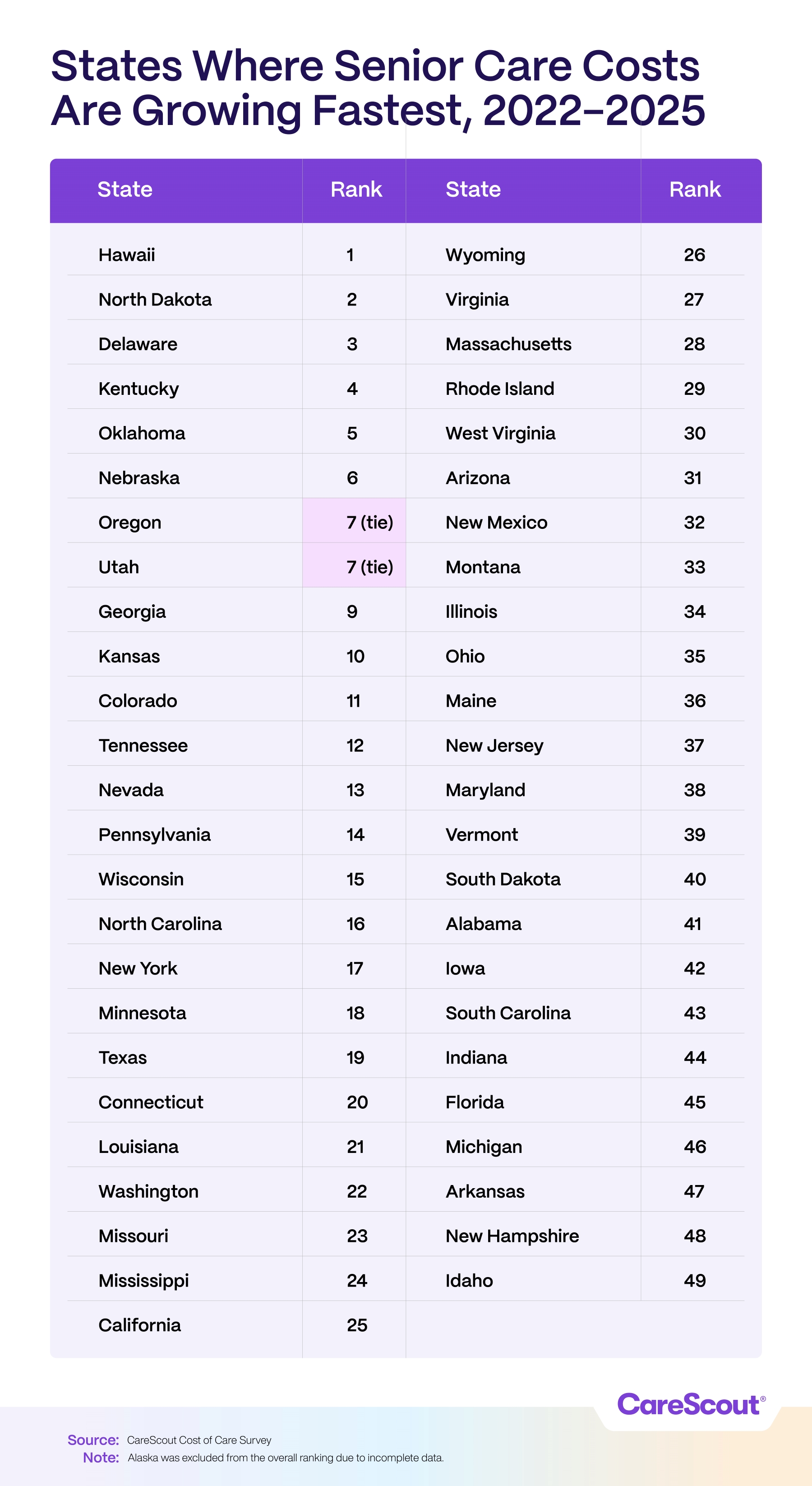
Hawaii is the No. 1 state, with senior care cost growth outpacing the rest of the country. It ranks in the top 10 for each of the four metrics, meaning families will struggle to find affordable options in any care setting. Hawaii's adult day health care costs rose 69.4% between 2022 and 2025 (No. 6 nationally), reaching $30,615. A private room in a nursing home, the most expensive option, reached $196,735 in 2025.
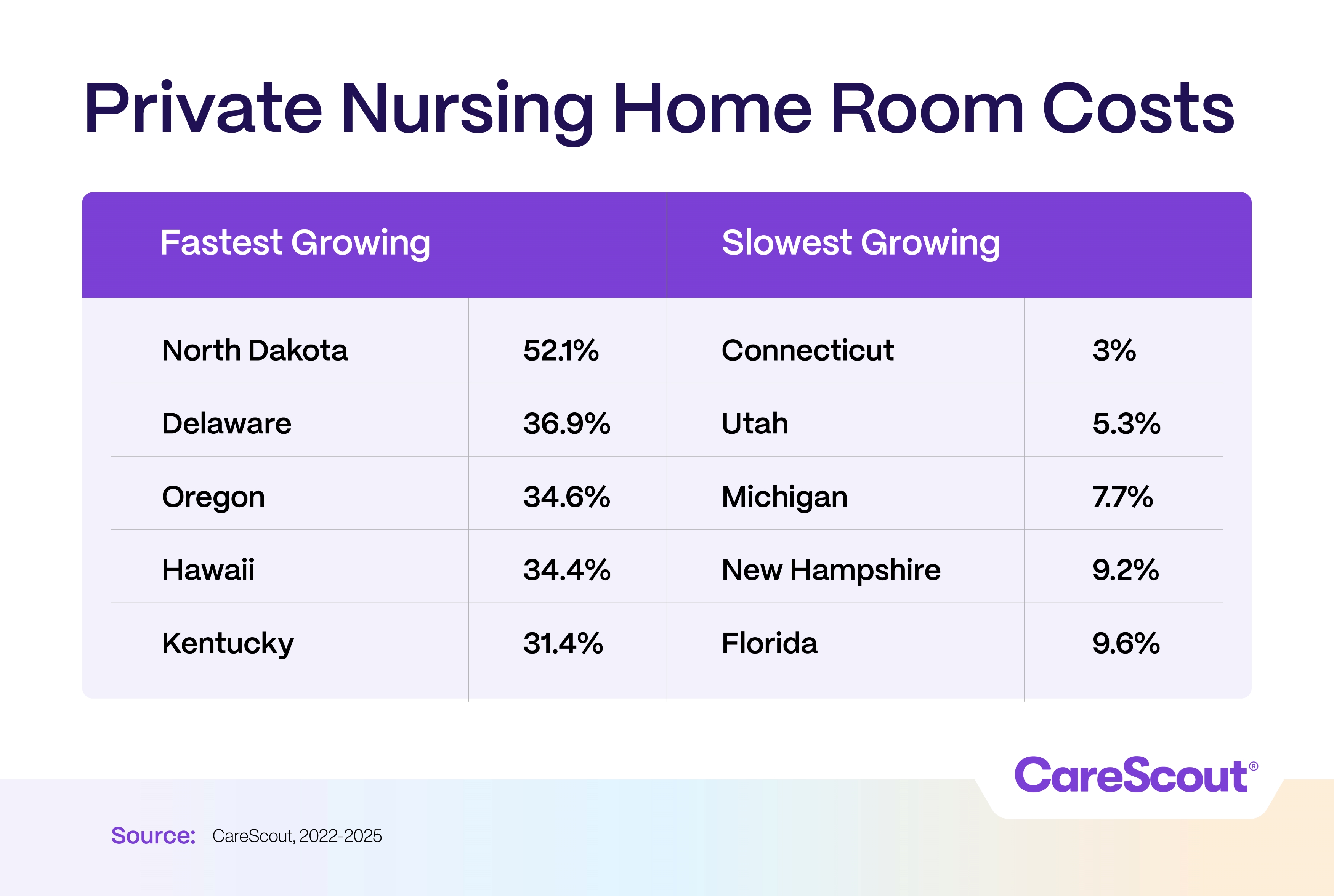
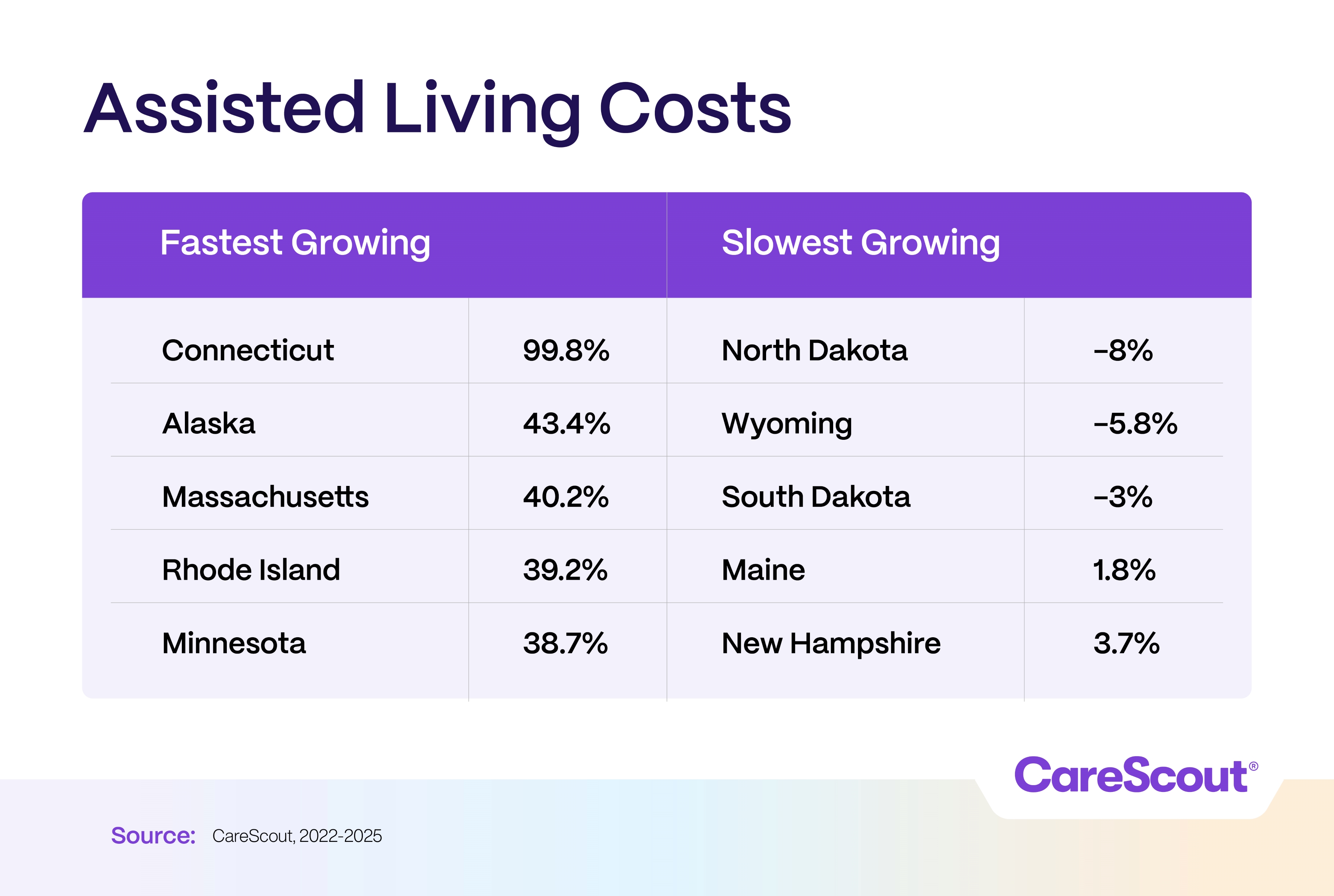
Meanwhile in No. 2 North Dakota, a private room in a nursing home cost $147,643 in 2025, up 52.1% from 2022 and the greatest increase in the U.S. – though assisted living costs actually fell by 8% (No. 50), hitting $56,745. No. 3 Delaware was close behind on nursing home costs, with private room costs rising 36.9% (No. 2) to reach $181,588.
No. 4 Kentucky and No. 5 Oklahoma rounded out the top five states with the fastest-rising senior care costs. A semi-private room in a nursing home costs $116,618 in Kentucky and $84,315 in Oklahoma, up 28.1% and 24.9% respectively since 2022. Both states rank in the top 10 for most other metrics as well.
Where Costs Are Most Stable
Senior care costs are most stable in Idaho, which ranked 49th overall. (Alaska and Washington, D.C. were not included in the overall rankings.) While Idahoans paid more in 2025 for a private room in a nursing home than they did in 2022 – an 11.4% increase – it was the only state where semi-private nursing home room costs actually fell, albeit slightly (-1.4%).
No. 48 New Hampshire was the second-most stable state, followed by No. 47 Arkansas. Both saw significant declines in adult day health care costs (-21.7% and -53.4%, respectively) over the three-year study period. However, nursing home and assisted living costs continued to rise in both states.
Also noteworthy: No. 46 Michigan and No. 45 Florida, where private nursing home room costs grew relatively slowly. In Michigan, a private room costs $143,628 per year, up just 7.7% (No. 47 nationally) from 2022. In Florida it's $146,000, up 9.6% (No. 45) – a relatively modest increase in a state with one of the largest senior populations in the country.
How Costs Changed Across Settings
Check out how states compare across the four key senior care settings we analyzed.
Private room in a nursing home: Reflects cost growth for seniors receiving 24/7 skilled nursing care in a fully private room, offering the highest level of medical support and personal privacy.
Semi-private room in a nursing home: Reflects cost growth for seniors receiving around-the-clock skilled nursing care in a shared room, combining intensive medical supervision with a lower-cost, shared living arrangement.
Assisted living: Reflects cost growth for seniors living in a residential community that provides help with daily activities like bathing, dressing and medication management, but does not offer the intensive medical care found in nursing homes.
Adult day health care: Reflects cost growth for structured daytime programs that provide supervision, social engagement and limited health services for seniors who live at home and return there in the evenings.
4 Tips for Families to Mitigate Rising Senior Care Costs
Do Not Wait for An Emergency: When an emergency strikes, families shouldn’t have to become expert care coordinators during the worst week of their lives. When that happens, families do not have time to compare facilities for price or quality of care. To mitigate this risk, it is critical to consult with an expert to create personalized care plans to help save money and find the best care.
Explore Inflation-Protected Long-Term Care Insurance: During an individual's peak earning years, it is advisable to explore long-term care insurance. Paying premiums while money is still coming in, can be advantageous to relying solely on government programs and savings if a prolonged health battle ensues. This offers peace of mind you can live out your golden years comfortably and helps safeguard any inheritance you hope to pass down. Pro tip: explore inflation-protected policies.
Be Proactive, Research Different Care Options: It is important to understand the different senior care options that are available. For example, nursing homes offer 24/7 medical care, while assisted living facilities do not – but help with bathing, dressing, and medication. Adult day health care and in-home services may offer more flexible or cost-effective alternatives to nursing home care, depending on your family’s needs.
Research Financial Assistance Programs: Medicaid, veterans benefits, and state-level programs can provide meaningful support for seniors who qualify, but rules vary widely by state and often require advance planning. Consulting with a care expert or financial advisor can help identify available programs and determine eligibility.
View The Complete Data
View how your state compares on cost growth across senior care settings in the graphic below. A look at the current actual costs in each state can be found in CareScout’s 2025 Cost of Care Survey.
Conclusion
Senior care costs are rising nationwide, but this analysis shows that the pace of growth varies dramatically from state to state. In some places, families are facing costs that have surged more than 50% in just three years. However, the market showed signs of slower growth in 2025 for the first time since COVID-19. As demand for long-term care continues to grow alongside an aging population, tracking these state-level trends will be critical to ensuring access, affordability and sustainable solutions.
Written by


Christine Healy
Christine Healy is the Head of Brand at CareScout. A growth strategist with over two decades of experience, Christine specializes in scaling mission-driven organizations across aging care, early education, and educational travel. She has previously held executive marketing roles at Bright Horizon...