

New analysis: care costs could total nearly 80% of family income for the sandwich generation



CareScout Analyzed Caregiving Costs for Older Americans and Children in Every State to Determine Where the Sandwich Generation is Most Cost-Burdened
For Americans simultaneously raising young children and helping care for aging relatives - a group known as the sandwich generation - the cost of paid care can create significant financial pressure.
A new CareScout analysis found that the combined annual cost of childcare for two children under five and a full-time non-medical caregiver for an older adult is equivalent to nearly 80% of the median income for a married household with children.
That figure represents the potential cost of paid care services relative to household income - not necessarily what an individual family pays out of pocket. Care needs and arrangements vary considerably and older adults may contribute their own financial resources toward care, rely on Medicaid once their assets are depleted, while some families may share expenses between generations. But the analysis illustrates the scale of the costs families may be navigating when care needs span generations.
If an older adult instead receives 20 hours per week of paid non-medical care, the combined cost is equivalent to 46.7% of median family income.
In 2024, 7.6 million Americans cared for both their own children and an older person, usually a parent, according to the Bureau of Labor Statistics. That means one in five adults who provide unpaid eldercare nationwide is part of the sandwich generation.
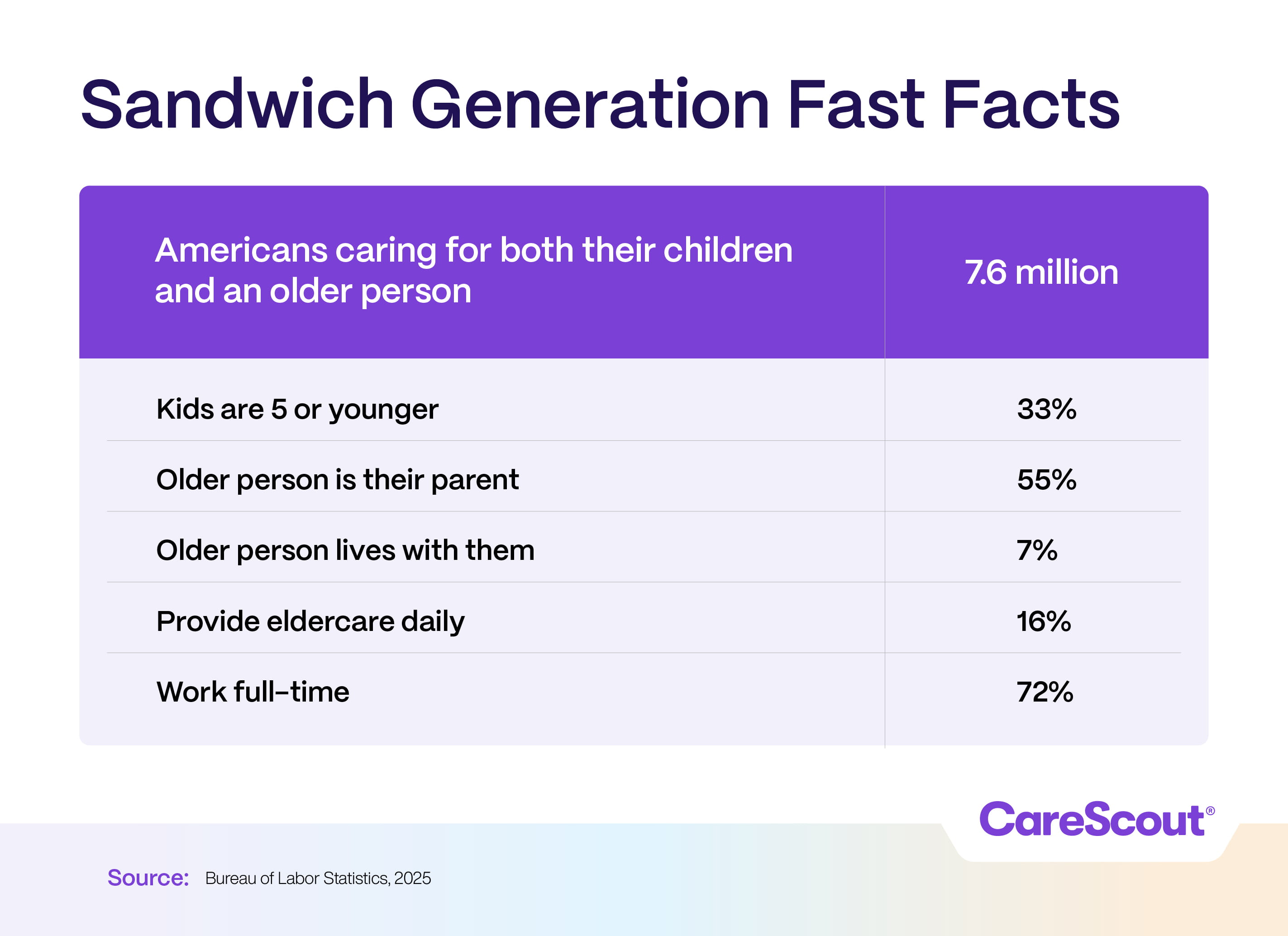 The financial impact of caregiving can extend well beyond the direct cost of paid care - particularly because nearly three in four family caregivers work full-time, BLS data shows. About a third of family caregivers have had to stop saving altogether, and 23% say caregiving has pushed them into debt, according to a report from AARP and the National Alliance for Caregiving.
That pressure isn't limited to lower-income households. A recent Bipartisan Policy Center survey found that families earning $50,000 to $100,000 per year are being squeezed hardest of all, often earning too much to qualify for public assistance but too little to comfortably absorb additional caregiving expenses.
The underlying costs of paid care can be substantial. Nationally, childcare for two kids under five averages $25,758 per year, according to the Bipartisan Policy Center, while the national median cost for a non-medical caregiver is $80,080 per year full-time, or $36,400 for 20 hours per week of care, according to CareScout's latest Cost of Care Survey. Meanwhile, the national median household income for a married family with children at home is around $133,000, Census data shows.
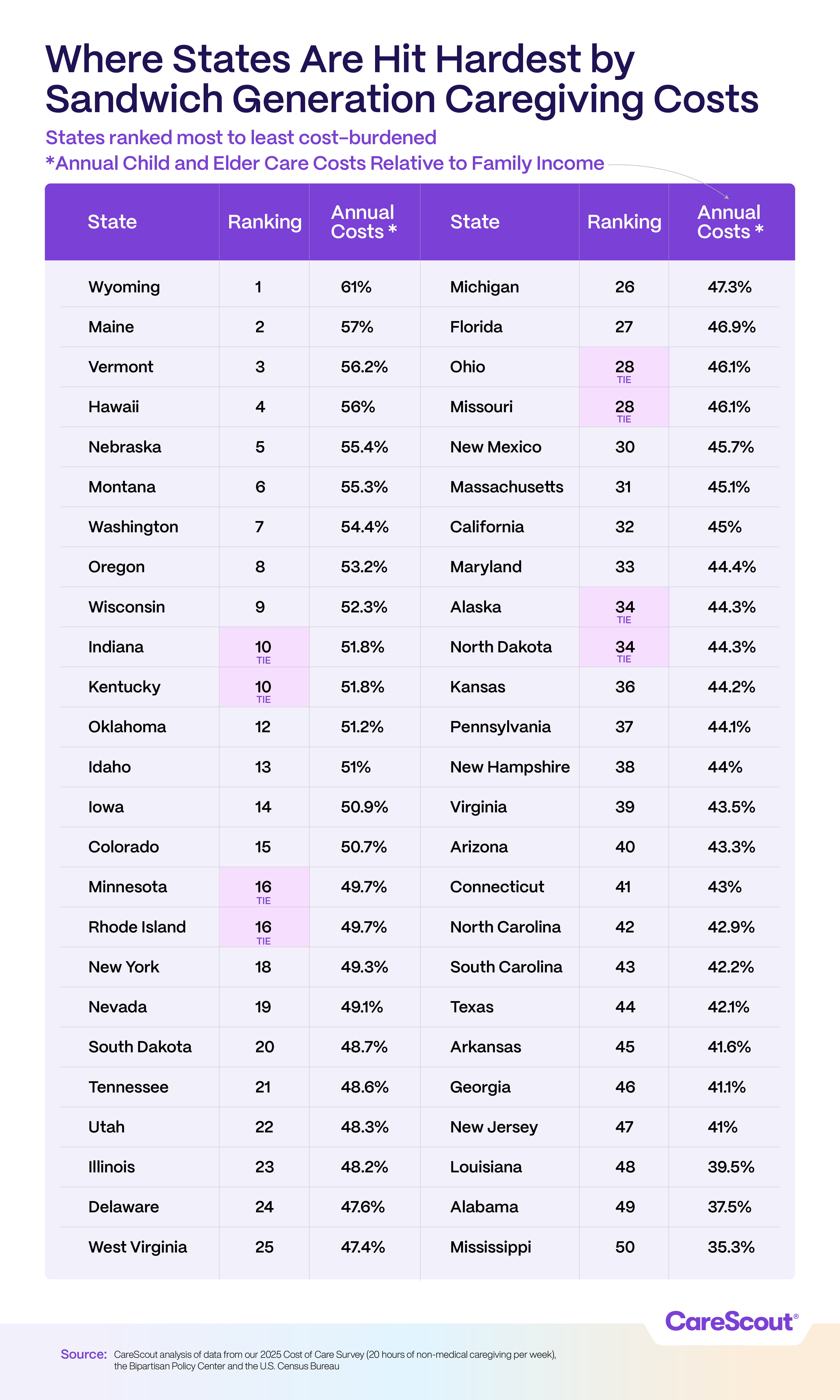
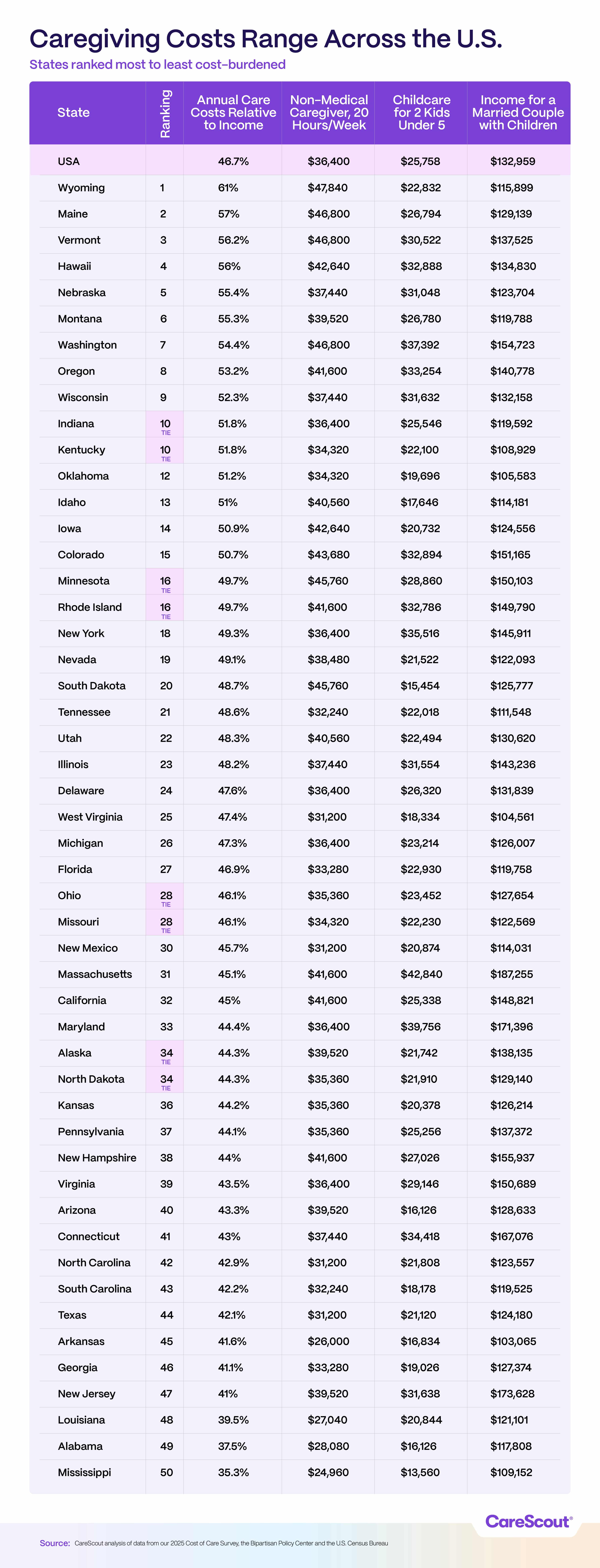
Those costs vary significantly across the U.S. and based on a family's care needs. In Wyoming, for example, the combined cost of childcare and part-time non-medical care would be equivalent to 61% of median family income. If full-time non-medical care is needed, the combined cost would exceed the state's median household income for married families with children. In Mississippi, by comparison, the equivalent share is considerably lower under both scenarios.
CareScout analyzed fees for childcare and non-medical caregivers across every state to understand where the potential financial pressure of paid care may be greatest for sandwich-generation families.
Key Findings
The National Squeeze: If the typical American family with two young children and a full-time non-medical caregiver for an aging relative were to cover the full cost of care for their aging relative, the combined cost of care (day care for the children and in-home care for their aging relative) would be equivalent to 79.6% of their household income – or 46.7% if the caregiver aide works part-time, at 20 hours a week.
Wyoming Is Hardest Hit: Wyoming families could spend 61% of their income – $70,672 per year – on child and part-time elder care. If they hired a full-time caregiver, and covered the full cost out of their income, they would spend $128,080 per year, eclipsing their $115,899 in household income.
Mississippi Is Least Burdened: Combined caregiving costs would make up 35.3% of family income in Mississippi because it has the nation’s lowest costs for both non-medical caregivers ($24,960 annually for part-time care) and childcare ($13,560 for two children), even though its median family income is also low ($109,152). If families hire a full-time caregiver instead, total costs would make up 62.7% of their income, still the lowest rate in the U.S.
Costs Outpace Wages in Hard-Hit States: Several of the hardest-hit states, including Wyoming, Maine, Vermont and Montana, are small, rural states where caregiver costs are beginning to outpace families’ incomes, which may reflect a shortage of care workers in less populated areas.
Hardest-Hit States
Wyoming tops the list: Childcare for two young kids and a part-time non-medical caregiver costs $70,672 per year, the equivalent of 61% of a typical family’s income. If they hired a full-time aide and paid the full cost out of pocket, they’d pay $128,080 per year in caregiving costs, which is more than the typical married couple with children earns ($115,899).
Meanwhile, Maine (57%), Vermont (56.2%), Hawaii (56%) and Nebraska (55.4%) round out the five hardest-hit states, each with the cost being equivalent to more than half of their household income on combined care.
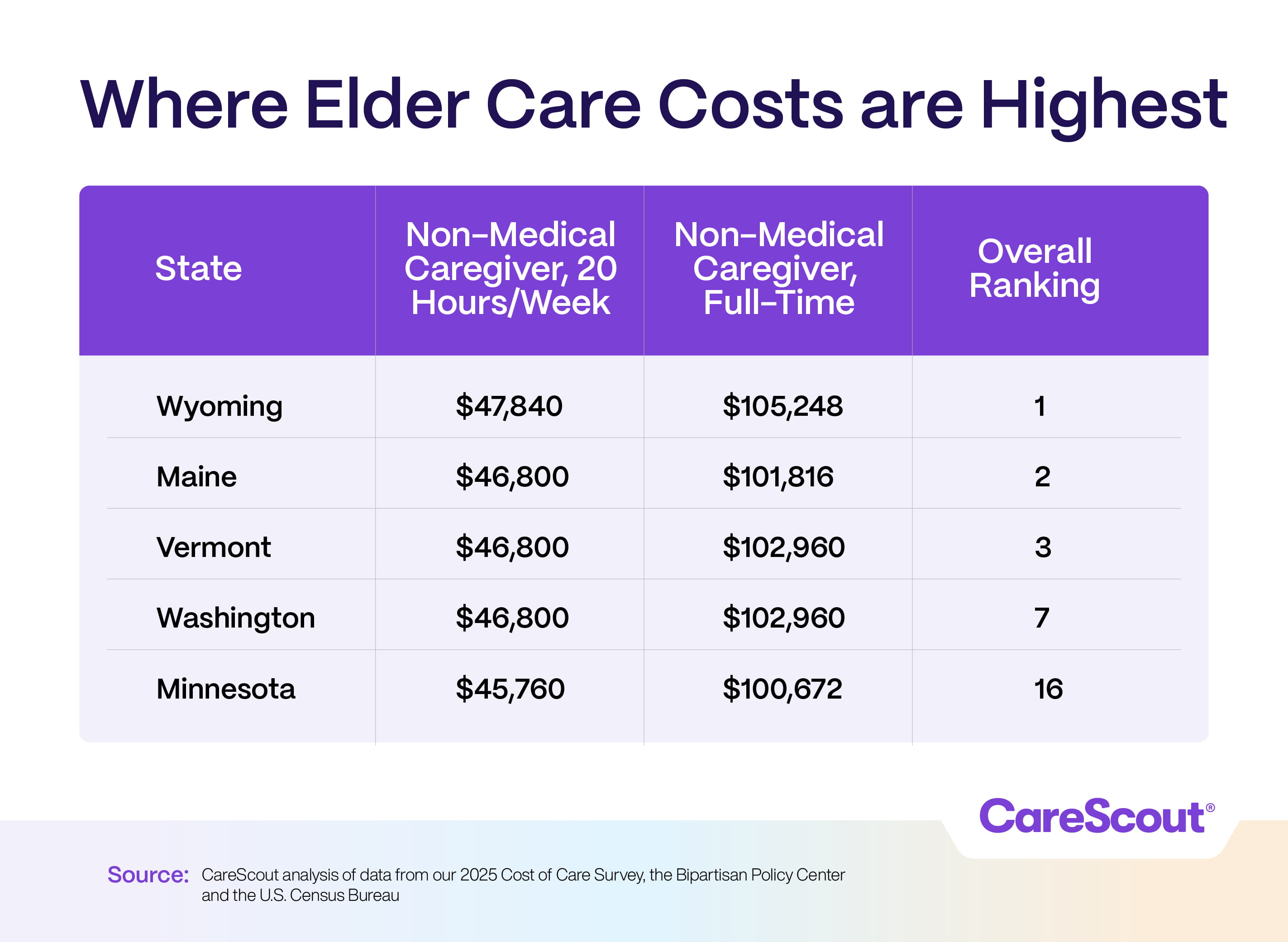
With the exception of Hawaii, where the cost of living is high across the board, these states share a cost problem rather than an income problem: part-time non-medical caregiver costs in Wyoming, Maine, Vermont and Nebraska range from $37,000 to $48,000 per year – above the $36,000 national median – even though household incomes in these states hover around the U.S. median of nearly $133,000. These states are also among the most rural, sparsely populated in the country, meaning a shrinking pool of available caregivers can drive up the price of in-home care.
Least Burdened States
Mississippi is the least burdened state in the country: If a family there bore the full cost of the in-home care, they would spend the equivalent of 35.3% of income – $38,520 per year – on childcare and a part-time non-medical caregiver, well below the national percentage of 46.7%. Alabama (37.5%), Louisiana (39.5%), New Jersey (41%) and Georgia (41.1%) round out the least-burdened states.
These states fall into two distinct groups. Mississippi, Alabama and Louisiana have some of the lowest caregiving costs in the country, with part-time non-medical caregiver fees under $28,000 per year and childcare running between $13,600 to $20,900 for two kids. This reflects the region’s lower cost of living, even though household incomes in these states also rank among the nation’s lowest.
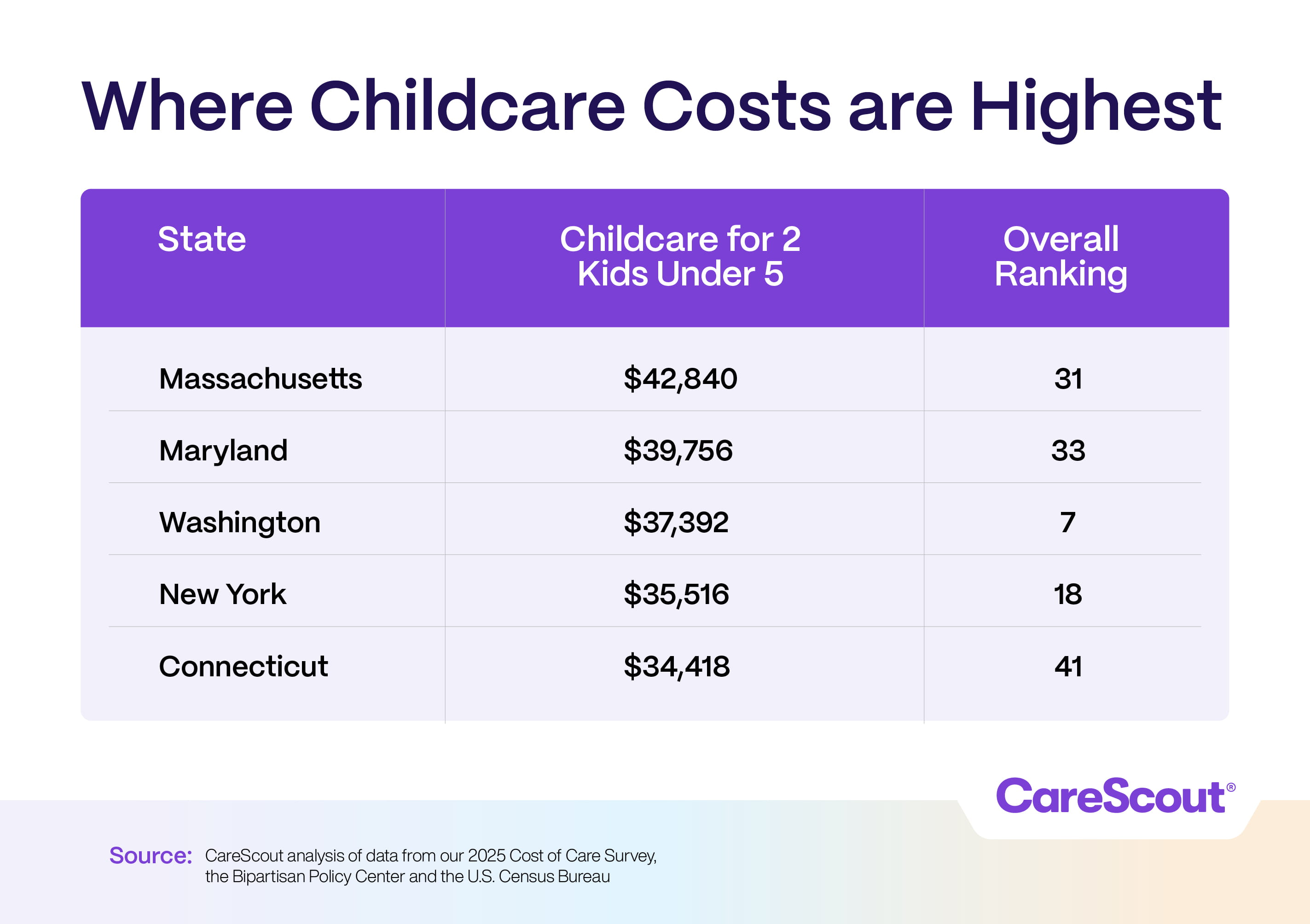
Notably, a few states with high childcare costs, like New Jersey and Connecticut, still land among the 10 least cost-burdened states overall. That's not because their elder care costs are unusually low – both rank in the middle of the pack – but because these states’ household incomes rank among the nation's highest, helping to offset the combined cost of childcare and caregiving.
5 Tips to Ease the Cost of Sandwich Generation Caregiving
Explore adult day centers. Adult day services are among the most affordable and underutilized care options available. For older adults who don’t require around-the-clock assistance, they can provide supervision, meals, activities and social engagement during the day while allowing family caregivers to continue working or take needed breaks.
Ask your employer about caregiving benefits. Backup care and caregiver stipends are increasingly common, but often go unused simply because employees don't know to ask.
Consider part-time or hybrid care. Cutting a non-medical caregiver's hours from full-time to part-time can save thousands of dollars per year. This can make a big difference in states where senior care costs are high.
Start planning for long-term care before you need it. Care needs tend to escalate faster than families expect, and emergencies can lead to rushed, expensive decisions. A CareScout Care Plan can help you anticipate what you may need before a crisis strikes.
Look for community resources. Local Area Agencies on Aging and nonprofit organizations might provide respite care, transportation, meal programs and caregiver support at little or no cost.
Full Data
Check out the full dataset below.
Conclusion
The sandwich generation is growing, but the cost of caring for children and aging relatives is rising faster than wages in many parts of the country. When it comes to closing that gap, families, employers and policymakers all have a role to play.
Methodology
For each state, we calculated the average annual cost of childcare (Bipartisan Policy Center, x2 kids) plus the cost of hiring a non-medical caregiver for either 20 hours per week (referenced above as “part-time”) or full-time (44 hours per week - CareScout), compared against the median household income for a married couple with children at home (Census Bureau). We ranked states based on the percentage of family income that went to caregiving costs for children and senior relatives. The analysis does not include Washington, D.C. because data was not available from CareScout or the Bipartisan Policy Center.
Written by


Christine Healy
Christine Healy is the Head of Brand at CareScout. A growth strategist with over two decades of experience, Christine specializes in scaling mission-driven organizations across aging care, early education, and educational travel. She has previously held executive marketing roles at Bright Horizon...