Best and worst states for senior care staffing in 2024


California ranked first for care staffing, supported by home health aide availability, fewer reported nursing home staffing shortages, and relatively low turnover.
Oklahoma ranked last, while Southern states made up most of the bottom 10 because of factors such as low staffing ratios and limited home health aide availability.
When comparing senior living communities, ask about staffing, turnover, training, licensing, citations, and professional caregiver experience.
A record 4.1 million Americans turned 65 in 2024, and the same number is expected to reach that age each year through 2027, a trend known as the “Silver Tsunami.” As life expectancy rises and adult children increasingly live farther from their parents, an unprecedented number of Americans will need aging care in the years and decades ahead. While care providers prepare for the projected demand, a critical part of the congregate care model remains at risk: adequate staffing.
At the beginning of 2024, 3.23 million people worked in long-term care communities, rebounding from a low of 2.96 million in 2022. Although that was welcome news, these communities remained 120,000 workers short of the pre-pandemic level in early 2020, according to the American Health Care Association. In addition, 99% of nursing homes reported unfilled jobs in a recent AHCA survey.
If you’re helping an older adult find care, these staffing trends matter. Staffing levels have been shown to be a leading indicator of care quality. As JAMA reported in early 2023, stable RN staffing levels are positively correlated with quality of care. A 2020 study also found a positive correlation between overall staffing levels and care quality. In short, staffing stability can shape an older adult’s care experience.
Despite the widely recognized importance of staffing, recruiting efforts have been hampered by burnout, low wages, and the rise of remote work. Retaining workers has also proved challenging, as reflected in the reported 52.1% median turnover rate at nursing homes.
At the same time, occupancy rates at senior living communities increased for the 10th consecutive quarter and were on pace to surpass pre-pandemic levels in 2024.
For families, these trends raise a practical question: Will the care system be able to support their loved ones in the years ahead?
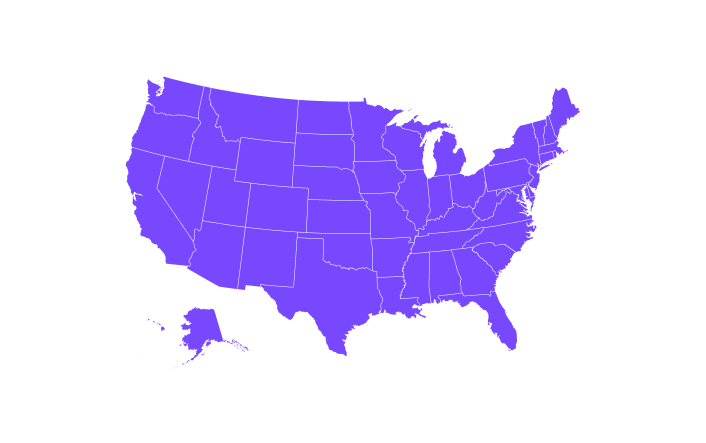
To help families understand the care landscape where they live, this analysis reviewed federal data across six metrics in all 50 states and Washington, D.C., to identify the best and worst states for care staffing in 2024.
The analysis used the most recent available data on nursing home staffing shortages and turnover, the ratio of health care workers to occupied nursing home beds, occupancy rates, primary care workforce adequacy, and the supply of home health aides. The complete methodology appears below.
Key findings
California ranked as the best state for care staffing: California had strong home health care availability relative to its older population, with 3.3 adults ages 75 and older per employed aide. It also had fewer nursing homes reporting staff shortages, at 4%, and lower nursing home staff turnover than most states, at 45.7%. Alaska, Washington, D.C., North Dakota, and Minnesota completed the top five.
Southern states dominated the bottom 10: Oklahoma ranked last, largely because it had 1.4 nursing home workers per occupied bed. Only Texas and Georgia had lower ratios, at 1.3, and both also ranked among the worst states. Utah and Montana were the only non-Southern states in the bottom 10.
Most states appeared poorly equipped to care for aging populations: Nursing home staff turnover rates exceeded 50% in 38 states. Only 17 states had a primary care workforce adequate to meet demand for medical services, and 24 states had at least 10 older adults per home health aide.
Top states
California took the top position, supported by its strong supply of home health aides. With 3.3 adults ages 75 and older per home health aide, California ranked second only to New York, which had 3 older adults per aide. In March 2022, only 4% of California nursing homes reported staffing shortages, while the state’s staff turnover rate of 45.7% was far below that of most states.
Alaska, Washington, D.C., North Dakota, and Minnesota completed the top five. Alaska, Minnesota, and North Dakota benefited from high ratios of workers to occupied nursing home beds, at 2.7, 2.3, and 2.1, respectively. Each also had a primary care workforce supply that exceeded demand. No. 4 North Dakota had a nursing home occupancy rate of 93.7%, slightly below No. 12 West Virginia at 93.8%.
Notably, Alaska and Minnesota ranked well despite having a high share of nursing homes report staff shortages in 2022, at 80% in Alaska and 64% in Minnesota.
Washington, D.C., ranked No. 3 because it had the country’s lowest staff turnover rate, at 37.8%.
Bottom states
At the other end of the rankings, Oklahoma placed last, driven by its low ratio of nursing home workers to occupied beds, at 1.4 workers per bed, and its low occupancy rate of 63.8%. The state has faced chronic understaffing in long-term care, which could help explain the low occupancy rate. Nursing homes may not have the capacity to accept more residents.
Missouri, Georgia, Tennessee, and North Carolina also ranked among the bottom five, and each had a low ratio of nursing home workers to occupied beds. Missouri, at No. 50, had a nursing home turnover rate of 61.4%. No. 49 Georgia had one of the lowest supplies of home health aides, with 18.6 residents ages 75 and older per aide. Alabama and Tennessee also ranked poorly for home health availability, with 18.2 and 17.7 older adults per aide, respectively.
Best and worst states by metric
Health care workers per occupied bed: The 2024 ratio of nursing home workers to residents indicates how much attention may be available to residents. Alaska ranked highest at 2.7, followed by Minnesota at 2.3 and Wisconsin and North Dakota at 2.1 each. Georgia and Texas ranked lowest at 1.3 each, followed by New Mexico, Missouri, Louisiana, Illinois, and Oklahoma at 1.4 each.
Share of nursing homes reporting staff shortages: This metric uses data from March 2022 to assess staffing consistency in recent years. Connecticut and California reported the lowest share of shortages, at 4% each, followed by Massachusetts at 8%. Alaska reported the highest share at 80%, followed by Minnesota at 64% and Maine at 59%.
Nursing home occupancy rate: Because most congregate care models rely on a certain occupancy level to cover fixed costs, a low occupancy rate can signal staffing or other quality cuts. West Virginia had the highest average occupancy rate at 93.8%, followed by North Dakota at 93.7% and New York at 92.8%. Oklahoma ranked lowest at 63.8%, followed by Texas at 66.7% and Montana at 69.4%.
Nursing staff turnover in nursing homes: A 2022 study found that turnover rates vary significantly among nursing homes and that higher turnover is associated with lower care quality. Washington, D.C., had the lowest turnover rate at 37.8%, followed by Hawaii at 39.7% and New York at 41.9%. Montana had the highest turnover rate at 67.8%, followed by Missouri and New Mexico at 61.4% each.
Primary care workforce adequacy: Primary care availability, including geriatric medicine, helps show whether a state’s health care system can meet the needs of an aging population. Alaska had the highest workforce adequacy at 145%, followed by Minnesota at 129% and North Dakota at 119%, meaning supply exceeded demand. Connecticut ranked lowest at 41%, followed by New Jersey at 50% and New York at 56%.
Home health aide supply: Many adults prefer to age in place, and the ratio of adults ages 75 and older to home health aides helps show how accessible this care may be. New York had the strongest supply, with 3 older adults per aide, followed by California at 3.3 and Washington, D.C., at 3.4. Florida had the lowest supply, with 31.7 older adults per aide, followed by Hawaii at 19.4 and Georgia at 18.6.
What can families do?
To address staffing shortages, the federal government proposed a rule that would raise minimum staffing requirements for about 75% of nursing homes. Among other requirements, nursing homes would have to provide residents with at least 0.55 hours of care from a registered nurse and 2.45 hours from a nurse aide every day. The government also committed to encouraging people to enter long-term care careers through scholarships and tuition reimbursement.
Government support for long-term care is important, but the complexity of staffing challenges means improvement may take time. If you’re looking for quality care now, the following steps can help you evaluate a senior living community’s staffing, training, and care practices.
5 tips for finding a quality senior living community amid staffing shortages
Ask about staffing levels: Ask about staffing levels, turnover, and professional caregiver qualifications, including the ratio of registered nursing staff to residents during different shifts. A long-term care community director should be able to explain workers’ backgrounds and training, whether 24-hour assistance is available, and which services the community offers.
Review onboarding and training: Ask about the community’s onboarding process for new workers and how much time it devotes each month to ongoing training. Because turnover is generally high across the industry, look for a provider committed to helping professional caregivers maintain the skills, knowledge, and current information needed to provide quality care.
Check licensing and citation history: Review the community’s licensing and accreditation history to confirm that it meets regulatory standards for care and safety. These standards cover areas ranging from emergency response systems to accessibility adaptations for older adults.
Stop and talk: Take time to speak with professional caregivers while touring senior living communities. Their interactions with residents can offer useful insight into the community’s care quality and culture. Asking about their experiences and approach to care can help you assess their dedication, compassion, and ability to support your loved one’s needs.
Ask people you trust: Reach out to friends and family for recommendations. Firsthand experiences from people in your network can help you understand the strengths and potential concerns of different communities.
Care staffing varies considerably across the U.S. Understanding differences at the state and community levels can help you plan for yourself or an older adult you support. Use these findings as a starting point, then ask each community specific questions about staffing, training, turnover, and care quality before making a decision.
Methodology
The analysis used the most recent available data for six metrics to determine which states were best and worst equipped to manage care staffing. A Z-score distribution scaled each metric relative to the mean across all 50 states and Washington, D.C., with outliers capped at ±2. Z-scores were multiplied by -1 when a higher score was negatively associated with being above the national average, including nursing home staff shortages, turnover, and the ratio of older adults to home health aides. Each state’s overall ranking was calculated using its average Z-score across the six metrics. The analysis included:
Median ratio of eligible health care workers per occupied nursing home bed, 2024 (Centers for Medicare & Medicaid Services))
Nursing home occupancy rates, 2024 (Centers for Medicare & Medicaid Services))
Share of nursing homes reporting staff shortages, March 2022 (Kaiser Family Foundation analysis of federal data)
Median nursing staff turnover in nursing homes, 2024 (Centers for Medicare & Medicaid Services))
Projected adequacy of the primary care workforce, including geriatric medicine, 2024 (Health Resources & Services Administration))
Home health aide supply, measured as the number of people ages 75 and older per home health or personal care aide, 2022 (Bureau of Labor Statistics and Census Bureau))
Search for aging care providers
Finding the right care starts with understanding your options. Use our Care Finder to search for providers, including those in the CareScout Quality Network.
Written by


Arthur Bretschneider, MBA
Arthur Bretschneider is Chief Product Officer at CareScout. As a third generation leader in the senior living industry, Arthur brings both deep compassion and a wealth of practical experience to his work at Seniorly. Arthur holds an M...